
I came out of the clinic into the flat Florida heat, still smelling of antiseptic and the faint, sweet rot of old flowers from the reception desk. My feet ached. Twelve hours on my feet, three emergency fillings, and a stack of charts to finish. I was thinking about a cold beer on the back patio, nothing more complicated than that.
Owen was waiting by my car, leaning against the driver’s door like he owned it. Which, technically, our joint bank account paid for. He was still in his sales manager uniform—gray slacks, crisp blue shirt, tie loosened—but his face was set in that hard, closed-off way that meant he’d been brewing on something all afternoon.
“You need to hear this,” he said, not even a hello.
I fished for my keys. “Can it wait until I’ve had a shower? I’ve had my hands in people’s mouths all day.”
“No, it can’t wait.” He straightened up. “My parents are getting worse. Dad’s hip is shot, and Mom can barely get out of bed anymore. They need someone in the house. Full-time.”
I stopped with the key halfway to the lock. “Okay. So are we talking about hiring a home health aide? Because I know a service we can call.”
He shook his head, a quick, dismissive jerk. “Not a stranger. Family. You’re going to move up there and take care of them. I’ve already packed a few of your things.”
I turned and looked at him then, really looked. The man I’d been married to for six years. The man who still couldn’t find the laundry detergent in our own house. He was telling me he’d packed my things.
“You packed my things,” I said. The words felt like they belonged to a different language, one where sentences like that made sense.
“A couple of suitcases,” he said, as if that was normal. As if this was a conversation about a weekend trip to the Keys. “I’m being helpful. You’re always saying I don’t help enough.”
“Helpful,” I echoed. “Owen, are you hearing yourself right now? You want me to quit my practice—a practice I spent eight years building—and move three hours north to be an unpaid nurse for your parents?”
He had the nerve to look confused, like I was the one being unreasonable. “It’s family. When family needs you, you step up. That’s how it works.”
“Whose family?” I asked.
That landed. I saw it flicker across his face, a micro-flinch before he bulldozed right past it. “Don’t start that. You’re my wife. My parents are your parents.”
“They didn’t call me on my birthday for the last two years,” I said quietly. “Your mother introduced me as ‘Owen’s little dentist friend’ at Christmas three years running. So I’m gonna need you to be very specific about which part of this is ‘family’ for me.”
He was done listening. He started talking over me, about how he’d already called his sister, how everyone knew the plan, how I just needed to give notice at the office and stop being dramatic. The word “dramatic” hung in the humid air between us like a gnat.
“We’ll talk at home,” I said finally, peeling the car door open.
“There’s nothing to talk about,” he said, and turned and walked to his own truck without looking back.
I sat in the driver’s seat with the AC blasting for a full two minutes before I pulled out of the lot.
—
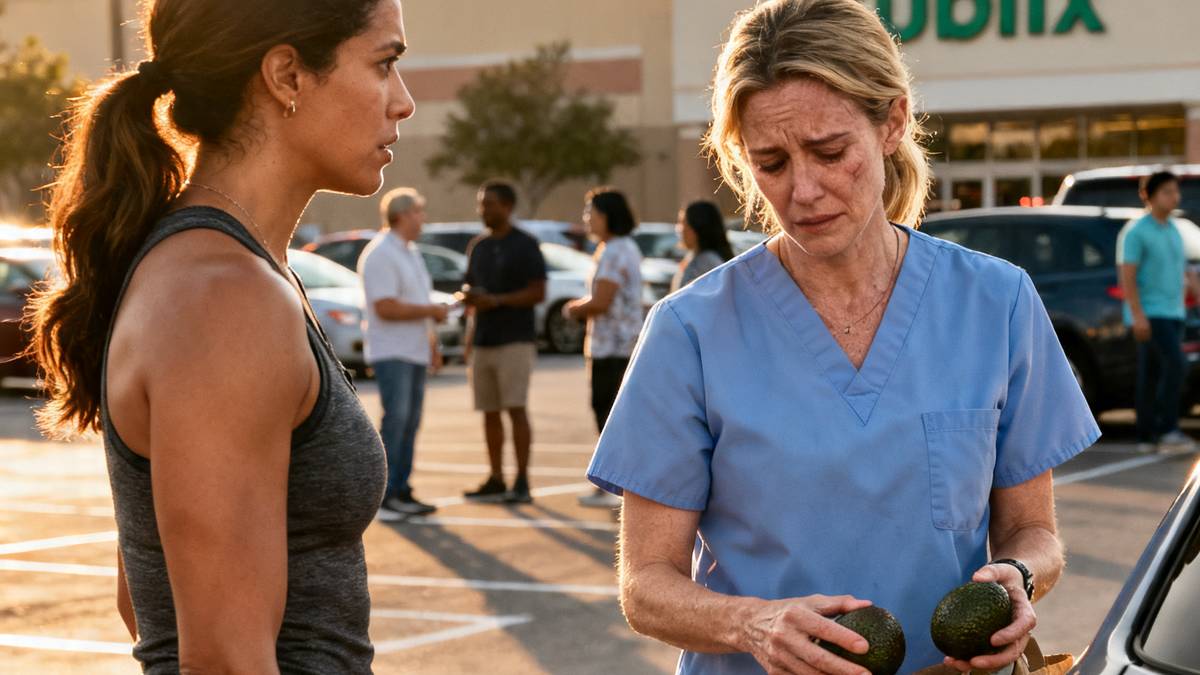
I didn’t go straight home. I stopped at the Publix on Livingston Road because I needed bananas and I needed ten minutes where no one was telling me what my life was going to be. I was in the produce section, squeezing an avocado I had no intention of buying, when I heard my name.
Jenna had a shopping cart full of toddler snacks and was holding two different brands of oat milk, comparing labels. We’d been in the same dental school study group, and now she ran her own practice two towns over. She knew my schedule, my coffee order, and the exact look on my face when a patient was lying about flossing.
“You look like death,” she said cheerfully.
“My husband just met me in the parking lot to inform me I’m moving to his parents’ house in Bunnell to be their full-time caretaker.”
Jenna set both oat milks down in the cart, slowly. “I’m sorry. Did you say ‘inform you’?”
“He used the words ‘you need to hear this’ and ‘I’ve already packed your things’. In that order.”
“He packed your things,” Jenna said flatly.
“That’s what I said.”
Jenna took a deep breath and leaned on the cart handle. “Okay. Let me get this straight. His parents have two children. Owen and his sister. His sister lives fifteen minutes from their parents’ house. Is that correct?”
“His sister’s name is Kaitlyn. She’s a stay-at-home mom with two kids in school all day. She has the time.”
“And instead of his sister, who is their actual daughter and lives right there, doing this, your husband has decided that you—a dentist with a full patient roster you built from nothing—need to quit your job and move into their house. To do it for free.”
“You’ve summed it up perfectly.”
Jenna stared at me. “Sarah. That’s not a plan. That’s a heist.”
I had to laugh. It was that or start screaming in the middle of the organic vegetables.
“What did you say to him?” she asked.
“I said we’d talk at home.”
“And when you get home, what are you going to say?”
I picked up a bag of lemons, the nice Meyer ones, and dropped them in my basket. “I don’t know yet. But I’m buying lemons. That feels like a start.”
—
The house smelled like the carnitas I’d left in the slow cooker that morning. Owen was already there, sitting at the kitchen island, scrolling his phone. He’d set three large suitcases by the front door.
Three. He’d been busy while I was at work.
“I grabbed the rest of your winter stuff from the guest closet,” he said without looking up. “You’ll need it up there. Gets cold at night, even in the fall.”
I set the grocery bag on the counter. “Owen. You need to stop packing and talk to me.”
“I’m not the one who needs to do something here,” he said. “I’ve done my part. I talked to Kaitlyn. She’s thrilled. She said she’s been so worried about Mom, and knowing you’re coming up to help just takes this huge weight off her.”
I felt something in my chest go very still. “You told Kaitlyn I was coming.”
“Yeah, she called while I was packing. I put her on speaker. She almost cried, she was so relieved.”
That’s when my phone rang on the counter. The screen lit up with a picture of Kaitlyn from last Easter, holding a mimosa and grinning.
I almost didn’t answer it. But curiosity, or maybe a little bit of spite, got the better of me.
“Sarah!” Kaitlyn’s voice came through bright and sugary. “Oh my God, Owen just told me! You are literally an angel, you know that? I’ve been so stressed out, like, I haven’t slept in weeks thinking about Mom and Dad, and now you’re just swooping in to save the day!”
“Hi, Kaitlyn.” I kept my voice even. “Can I ask you something?”
“Of course! Anything!”
“Why aren’t you taking care of them?”
The pause was a fraction of a second too long. “Well, I mean, you know I’ve got the boys, and their schedule is just insane, and Tom’s traveling all the time for work now. I’m barely keeping my head above water as it is.”
“Right, but you live in Palm Coast. That’s like a twenty-minute drive from their place. And the boys are seven and nine. They’re in school until three every day.”
“Well, yes, but that’s just the thing, you know? By the time they get home, I’m running them to soccer and piano and—”
“So you can’t do it,” I said calmly. “Even though you’re their daughter, and you live right there, and you have several hours a day free while your kids are at school. You can’t do it.”
“Sarah, I don’t think you understand how busy my life is.”
“Oh, I understand perfectly. So let me ask you another question, Kaitlyn. If you were the one in my shoes, and I was asking you to walk away from your whole career and your home and your husband, what would you think?”
Silence. Then a nervous little laugh. “Well, that’s different. You don’t have kids. You’re more… flexible.”
“Flexible,” I repeated. “Right. So the fact that Owen and I don’t have children means my time is worth less. My career is worth less. My life is a resource you all get to deploy as needed.”
“That’s not what I’m saying!”
“But it is, though. It really, really is.” I let the silence stretch for a beat. “I’m going to ask you one more thing, and I want an honest answer. Are you and Tom planning to contribute any money toward your parents’ care? Since you’re not contributing your time?”
Kaitlyn exhaled, clearly relieved to be back on solid ground. “Yes! We talked about it, and we’re going to send three hundred dollars a month. That’s more than fair, right? To help out?”
Three hundred dollars. For full-time, live-in caregiving in the year twenty-twenty-four.
I actually laughed. A real one, from the belly, the kind that comes out when something is so absurd it circles all the way back around to hilarious.
“Kaitlyn,” I said, still chuckling. “A home health aide in Flagler County charges twenty-eight dollars an hour. Full-time, that’s about four thousand dollars a month. You’re offering me three hundred. And you think that’s generous.”
“Well, we’re family! You can’t put a price on—”
“On what? My labor? My entire existence?” I took a breath and felt the laugh settle into something harder, sharper. “I’m going to hang up now. Give your parents my best. Honestly. I hope you figure something out.”
I ended the call before she could respond.
Owen was staring at me from across the kitchen island. I couldn’t read the look on his face. Something between anger and confusion and a third thing he probably didn’t have a word for.
“That was rude,” he said.
“That was honest. There’s a difference.”
He pushed back from the island and stood up. “Okay, I’ve had enough of this. You’re going. The bags are packed, the car has gas, I already told my mom to expect you in the morning.”
I looked at the suitcases by the door. Three of them. He’d folded things I hadn’t worn in years. The old ski jacket from our trip to Breckenridge was draped over the top of the biggest one.
“You really packed my whole closet,” I murmured. “You, who can’t even pack your own gym bag without asking me where your socks are.”
“I’m stepping up,” he said, puffing his chest a little. “I’m handling things. This is what you wanted, right? Me taking initiative?”
I almost laughed again. “Initiative is planning a date night, Owen. Not planning my resignation.”
But he wasn’t hearing me. He was already on his phone, thumbs flying. “I’m texting you Mom’s address. You’ve never been up there, right? I’ll send the gate code too, in case they’re asleep when you get there.”
His phone buzzed. My phone buzzed with the incoming message. He’d typed out the address, the gate code, and a little note: *Make sure you bring in the mail when you get there. The box is by the front gate. Thanks, babe.*
Thanks, babe.
I walked over to the suitcases. Unzipped the front pocket of the biggest one. Inside, he’d put my passport, my social security card, and the small jewelry box my grandmother had left me. He’d been thorough.
“I’m going to bed,” I said. “We can talk more in the morning.”
Owen looked up, a quick, hopeful grin. “So you’re going? You’re really going?”
I didn’t answer. I just walked back to the bedroom and closed the door.
—
The next morning, I was up before him. I showered, dressed in a light linen blouse and comfortable jeans, and made a pot of coffee. Owen came shuffling out around seven, hair sticking up, and his face broke into that same hopeful grin when he saw me dressed.
“You’re ready,” he said, pouring himself a cup. “That’s my girl. I knew you’d come around.”
“I need you to do something for me,” I said. “Since you were so helpful with the packing.”
“Anything.” He was practically beaming.
“I need you to load the suitcases into my car.”
He did it with the enthusiasm of a kid carrying luggage for a Disney trip. Hauled all three out to the Lexus, arranged them carefully in the trunk, even went back inside and grabbed my travel mug and filled it with fresh coffee. He set it in the cup holder and stepped back, dusting his hands off.
“There,” he said. “All set. You know, I’m really proud of you for doing this. I know it’s a big ask, but it’s the right thing. You’ll see.”
I climbed into the driver’s seat and pulled the door shut. Lowered the window.
“Thank you for packing,” I said.
“Drive safe,” he said, and bent down to kiss me. I let him. It was a quick, perfunctory peck, the kind you give someone you’ve already stopped seeing.
I pulled out of the driveway. Watched him in the rearview mirror, standing there in the morning sun, arms crossed, posture loose and satisfied. The conquering general watching his troops march to war.
—
I didn’t take I-95 north. I turned left on Pine Ridge instead of right, and I drove to my office.
Dr. Elaine Mercer, my partner, was already there. She’d been at the practice for thirty years, hired me fresh out of my residency, and treated me more like a daughter than an employee. I’d called her the night before and told her everything.
She was waiting with a fresh coffee and a key.
“The apartment above the office,” she said, pressing the key into my palm. “It’s not much. A kitchenette, a pull-out couch, questionable plumbing. But it’s yours as long as you need it. Rent-free for the first two months.”
“Elaine, I can’t accept that.”
“You can and you will.” Her eyes, sharp and knowing behind her reading glasses, studied my face. “You didn’t quit your job and drive away from your whole life just to argue with me about a pull-out couch. Get your things upstairs. I’ll see you in the clinic at nine.”
I hugged her. I’m not usually a hugger, but I hugged her so hard she squeaked.
—
It took me seven trips to get all three suitcases up the narrow staircase to the little apartment. The pull-out couch was, as promised, questionable. The kitchen had a mini-fridge and a hot plate and a window that looked out over the parking lot, where the morning light was just starting to glint off the bumpers of the cars.
I unpacked one bag—just enough for the week. The rest could wait.
I was folding a blouse when my phone rang. Owen.
I let it ring. It stopped. Then buzzed with a text: *Everything okay? Mom said you’re not there yet. Call me.*
I set the phone face-down on the tiny counter and finished my coffee.
Around ten, Elaine buzzed my room from the clinic line. “Sarah, your phone has been ringing off the hook down here. The receptionist says your husband has called four times. And a woman named Kaitlyn twice. Want me to tell them anything?”
“Tell them I’m with a patient.”
“Are you?”
“I will be in five minutes.”
She chuckled and hung up.
At noon, I had a short break between a cleaning and a crown prep and I allowed myself to glance at my phone. Fourteen missed calls. A string of texts from Owen that evolved from confused to annoyed to angry.
*Where are you??*
*Mom’s been waiting all morning. This isn’t funny.*
*Sarah answer your phone.*
*You’re not seriously doing this. You’re not actually bailing on my parents. That’s low, even for you.*
*I carried your goddamn bags. Answer your phone.*
The last one had come in six minutes ago.
I typed out a single reply: *The bags were very helpful, thank you.*
Then I blocked his number.
I blocked Kaitlyn’s too. And his mother’s, just to be safe.
—
He showed up at the clinic at four-thirty, right as I was finishing up with Mrs. Patterson’s bridgework. I saw him through the window in the door to the reception area, pacing back and forth by the empty chairs, his face flushed and damp with sweat. He’d driven all over town looking for me, I guessed. Probably started at his parents’ house and worked his way back, growing more frantic with every mile.
I waited until he saw me. Let him make eye contact through the glass before I turned and walked calmly back to my office.
He followed, of course. The receptionist tried to stop him, but he was too quick, too angry. He burst through my office door and slammed it behind him.
“What the hell is this?” His voice was a low, shaking growl. “I’ve been calling you all day. My mother has been sitting by the door waiting for you. She made a casserole. A casserole, Sarah.”
“That was thoughtful of her,” I said, not standing up.
“Where are you?” He looked around the office, at my diplomas on the wall, my desk cluttered with patient charts and the little jade plant I’d kept alive for five years. “Where have you been? Where did you go last night?”
“I’ve been here. Seeing patients. I had a full schedule today, you know. It’s a lot to walk away from.”
He stared at me. The anger was still there, but something else was creeping in around the edges. Confusion. Maybe the first cold tendril of fear.
“The bags,” he said slowly. “You let me load the bags into your car.”
“Yes.”
“You were going to leave. I thought you were going to leave.”
“You decided I was going to leave. I never said I was. I never said anything that a reasonable person would interpret as agreement.” I leaned back in my chair. “You told me I was going to Bunnell. You told your sister I was going. You packed my things. You loaded my car. At no point in any of that did I actually consent to any of it. You just assumed.”
His mouth opened and closed. A fish on a dock.
“You tricked me,” he finally said.
“I didn’t trick you. I just didn’t stop you. There’s a difference.”
“Where are my bags?” A new thought seemed to hit him, and he looked at me with dawning horror. “Where are my suitcases? Those were expensive.”
“They’re in a safe place.”
“Sarah, this is insane.” He was switching tactics now, trying on a calmer voice, the one he used to close deals with hesitant buyers. “Come on. Let’s just talk about this. Let’s be reasonable adults. If you don’t want to go to Bunnell, okay. We can figure something else out. But you can’t just leave. We’re married.”
“We are,” I agreed. “And for six years, you’ve made decisions for both of us and called it leadership. You’ve told me what we were doing, where we were going, what my role was. And I let you, because I believed you when you said it was partnership. But a partner doesn’t pack your bags and order you to quit your job. A partner asks. A partner listens.”
“I’m listening now!” He threw his hands up. “I’m here, aren’t I? I’m asking you to come home!”
“You’re here because I didn’t show up where you put me. You’re here because your plan fell apart. That’s not the same thing.”
He opened his mouth, ready to argue, ready to cycle through more tactics, more angles. I’d seen him do it a hundred times with a floundering client. The good-cop pivot. The guilt trip. The logic trap.
I’d learned from the best.
“Owen,” I said, and the quiet in my voice made him stop mid-sentence. “I’m going to say this once. If you keep pushing me right now, if you raise your voice again or try to order me again, I’m going to file for divorce. Electronically. From my phone. It takes about fifteen minutes, and I’ve already bookmarked the page. Do you want to see how serious I am?”
He froze. The word “divorce” hung in the air like a blade, still swinging from where I’d released it.
“You wouldn’t,” he whispered.
“Try me.”
We looked at each other across the desk. I’d seen the man across from me a thousand times—in the morning after a fight, his back turned in bed; in the evening, scrolling his phone while I talked about my day; in the kitchen, telling me what “we” had decided without ever asking me a single question. But I’d never seen him quite like this. Face pale. Shoulders sagging. Eyes skittering around the room like he was looking for the door, looking for an angle, looking for some way to get the script back on track.
“Where should I go?” he asked finally. His voice was smaller than I’d ever heard it.
“Anywhere you want. You’re good at making decisions.”
He walked out. I heard the front door of the clinic swing shut. Through the window, I watched him get into his truck and just sit there for a long minute, engine running, hands on the wheel, going nowhere.
—
Kaitlyn called the clinic the next day, pretending to be a new patient trying to schedule a cleaning. The receptionist, who had been briefed, put her on hold for fifteen minutes and then told her our next available appointment was in March. Kaitlyn hung up.
Owen’s mother left a voicemail on my office line, which I didn’t discover until the end of the day. She sounded genuinely bewildered, and genuinely hurt. “I don’t understand, sweetheart, I had the guest room all fixed up. I even went and bought those little lavender soaps you like. Owen said you were coming. Was it something we did?”
I didn’t call her back. She hadn’t done anything. That was almost the worst part—she’d been pulled into the current of Owen’s certainty just like I had, just like everyone always was. She was just another object he’d rearranged, another detail in the plan that didn’t account for anybody’s will but his own.
A week passed. Then two. I worked my shifts, came upstairs to my little apartment with the questionable couch, and slowly filled the mini-fridge with my own groceries, my own choices. Yogurt I liked. A bottle of wine that was just for me. Lemons, lots of lemons, because I’d discovered that squeezing fresh lemon into hot water every morning was a ritual I could build a new life around, one small stone at a time.
I filed the papers on a Thursday. Electronically, just like I’d said. It took seventeen minutes.
Owen got served at work on Friday. By Monday, he’d called my office sixteen times. By Tuesday, he’d stopped.
Elaine brought me coffee on Tuesday afternoon and sat down across from me in the break room. “You know,” she said, “I’ve seen a lot of people walk away from a lot of things over the years. Bad marriages, bad partnerships, bad jobs. But I’ve never seen anyone walk away with their luggage already packed by the person who was pushing them out the door.”
I smiled into my coffee. “He was very helpful.”
“He was an idiot.” She clinked her mug against mine. “To the pull-out couch. May it be the least comfortable bed you ever sleep in.”
“To the pull-out couch.”
That night, I lay on the lumpy mattress and stared at the ceiling and thought about the house I’d left behind. The slow cooker still on the counter. The carnitas I’d never gotten to eat. The suitcases he’d packed with my grandmother’s jewelry and my winter coat and that old, hopeful conviction that I would always, always do what he said.
He’d handed me the bags. He’d loaded the car. He’d sent me on my way.
The only thing he’d gotten wrong was the destination.
I got up and opened the window. The Florida night was warm and full of cicadas, and somewhere in the distance, a car alarm was going off, insistent and ignored. The city was out there, and my little office and my patients and a future I’d almost let someone pack away into a suitcase and ship off to a place I’d never even seen.
I had the gate code, though. I still remembered it.
I pulled out my phone and deleted the text.

