
The receptionist at the Dallas fertility clinic had the exhausted look of a man who'd already explained the same thing four times in the last hour.
"Ma'am, I understand your frustration," he said, his voice level but tightening at the edges. "But federal law is clear. The patient is thirty-two years old. Unless she signs a release, I can't give you her file."
Delia Carver leaned across the counter, her silk blouse rustling against the laminate. "I'm not *ma'am* to you. I'm her mother. I paid for every IVF cycle. I co-signed the loan on her condo. What exactly do you think gives you the right to call me a stranger?"
Behind her, near the glass doors leading to the parking lot, Sasha stood frozen. Her knuckles had gone white around the strap of her leather tote. The August heat outside had left a faint sheen on her forehead, but right now she couldn't feel anything except the dull roar of blood in her ears.
She'd booked the 7:30 a.m. appointment for a reason. Deleted the shared family calendar app. Left her phone at home, actually—tossed it in the kitchen drawer under the takeout menus—because she knew her mother tracked the location. Twenty-three miles from downtown to this quiet clinic in Cedar Park, and somehow Delia had still beaten her here.
"Sasha Mae Carver." Her mother's voice cut through the lobby. She hadn't turned around. She didn't need to. "Tell this man to hand over your chart. Right now. What are you hiding this time? Another failed transfer you're too ashamed to admit? Or did you and Jake finally split and you're storing embryos with some other man?"
The word *embryos* landed like a slap. Two other patients in the waiting area suddenly found their phones fascinating.
Sasha said nothing.
She'd learned this particular silence at fourteen, when her mother had found her journal—not by accident, but by prying open the locked drawer of her desk with a butter knife while Sasha was at volleyball practice. She'd perfected it by nineteen, when Delia had called her academic advisor at UT Austin, impersonating Sasha, and tried to change her major from graphic design to pre-law.
When Sasha moved into her own place at twenty-five, the silence became a strategy. Her mother just adapted—befriended the building's concierge, ran a background check on every roommate, and once showed up at a housewarming party uninvited with a notepad, interviewing Sasha's friends about their "intentions."
Some distances aren't measured in miles.
"You've got about ten seconds," Delia said, still facing the counter, "before I call your father and tell him his daughter is keeping medical secrets from the family again. You remember how that went last Christmas."
The receptionist opened his mouth, but a new voice cut in from the hallway.
"That's enough."
Dr. Okonkwo, the clinic director, stepped into the lobby. She was a compact woman in navy scrubs, and she moved with the kind of calm authority that came from twenty years of delivering bad news and good news in equal measure. Two security guards flanked her—one a retired cop Sasha recognized from previous visits, the other a young guy built like a linebacker.
"Mrs. Carver, you are disrupting patient care. If you don't leave voluntarily in the next sixty seconds, I'm calling the Cedar Park police, and I'll have you trespassed from the property. That will go on your record."
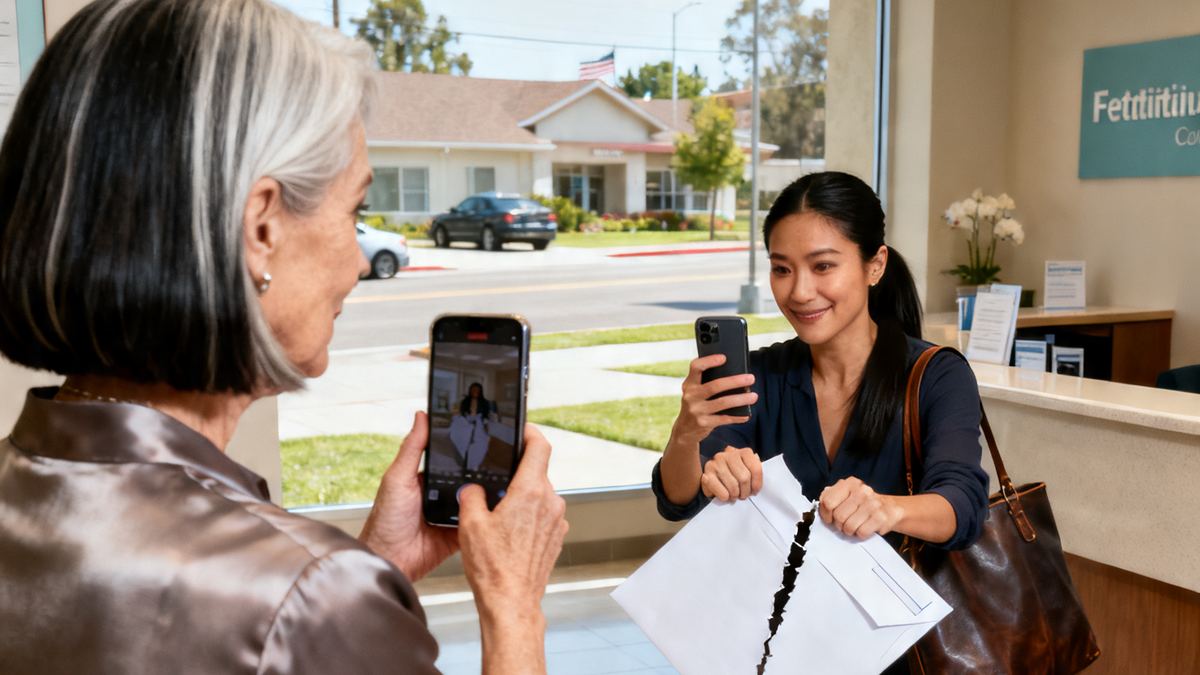
Delia laughed. It was a bright, jagged sound. She pulled her iPhone from her purse and tapped the camera icon.
"Perfect. Say that again—I want it on video." She aimed the lens at Dr. Okonkwo, then pivoted toward Sasha, still standing motionless near the door. "Go ahead, sweetheart. Let's show the world what kind of clinic hides medical records from a concerned mother. How do you think this looks on Instagram? On Nextdoor? I've got four hundred contacts in this city, Sasha. By lunchtime, everyone you know will be asking what you're hiding."
The phone's camera light blinked. Recording.
Sasha lifted her chin.
She wasn't fourteen anymore. That was the thing. You spend decades bracing for the blow, and then one morning you realize the fist has been swinging at air for years. You've already left. You just forgot to tell your body.
"Mom," she said.
Her voice came out steady. Quieter than she expected. Almost gentle.
"You're not fighting for my wellbeing right now. You're fighting for access. There's a difference." She took one step forward, then another, until she stood beside the reception desk. "I needed you to hear that from me. Not from a doctor, not from a lawyer. From me. And this is the last time I'm going to say it."
Delia's smile flickered. The iPhone dipped an inch.
"Excuse me?"
"I'm done. The check-ins, the hacking into my accounts, the showing up unannounced—all of it. It ends today." Sasha reached into her tote and pulled out a thick white envelope. The clinic's logo was stamped on the corner. "These are my test results. The thing you drove all the way up here to steal."
Her mother's eyes locked on the envelope. She'd gone very still.
"Hand it over."
"No." Sasha didn't raise her voice. She simply gripped the envelope with both hands and tore it in half. Then quarters. Then eighths. The sound was crisp and final, like celery snapping.
Delia made a choked noise. "What are you—stop it—"
Sasha walked to the wastebasket beside the water cooler and let the shreds fall. A blizzard of white paper, glossy photo printouts, a corner of what might have been a lab report.
"There. Now you can sort through the trash if you want to." She turned to face her mother. "That's the only version you're ever getting."
For the first time in thirty-two years, Delia Carver had nothing to say. Her mouth was open. Her camera was still recording an empty patch of floor.
Sasha walked out.
The glass doors swung shut behind her. The Texas sun hit her face like a wall, but she didn't flinch. She crossed the parking lot to her Subaru, got in, and sat with her hands on the wheel for a full minute before she realized she was shaking. Not from fear. From something lighter. Something that almost felt like oxygen.
Inside the clinic, Delia stood motionless for three full seconds. Then she lunged for the wastebasket.
"Ma'am—you can't do that—" The linebacker guard moved toward her, but Dr. Okonkwo held up a hand.
"Let her. It's trash. She's welcome to it."
Delia was already on her knees, scooping handfuls of torn paper onto the tile floor. Her silk blouse snagged on the edge of the bin. Her manicured nails scrabbled through coffee grounds and crumpled tissues. The other patients stared. The receptionist turned back to his computer, jaw tight.
Four minutes later, Delia was on a bench outside the clinic, pieces of the destroyed envelope spread across her lap. She'd always loved puzzles. Crossword, jigsaw, Sudoku—anything that rewarded patience and precision. She sorted the fragments by color first, then by the shape of their edges. White side. Glossy side. A corner with a barcode. A strip that read *PATIENT: CARVER, SASHA M*.
The sun climbed higher. Cars pulled in and out of the lot. A woman with a toddler gave her a wide berth.
Finally, she assembled enough to read.
The first thing that clicked into place was a name she recognized. Not Sasha's.
*Genetic comparison: subject CARVER, SASHA M. (donor) versus CARVER, NATHAN P. (alleged full sibling). Results indicate a half-sibling match at 24.7% shared DNA. Probability of same biological father: 0.02%. Discrepancy consistent with different paternal lineage.*
Delia's hands stopped moving.
She reread it. Three times. Four.
Nathan was Sasha's younger brother. Delia's golden boy. The one who looked nothing like his father—everyone always said so, and Delia always laughed and blamed it on her side of the family. Her husband, Michael, had dark hair and brown eyes. Nathan was blond and blue-eyed, like his mother.
And apparently, like someone else entirely.
The world tilted. The hum of traffic on the interstate faded to a dull whine. Delia sat there, a fifty-eight-year-old woman in a four-hundred-dollar blouse, clutching trash-paper on a bench in a suburb she'd driven an hour to get to, and realized the secret she'd been chasing for years—hunting, tracking, prying open any door she could find—wasn't Sasha's.
It was hers.
Twenty-six years ago. Austin. A conference, a hotel bar, a fight with Michael that had felt catastrophic at the time. A man whose face she'd mostly blurred out. Six weeks of denial. A positive test. A choice to never, ever speak of it again. And the slow, creeping certainty, buried so deep she'd almost believed it herself, that if she just controlled everything hard enough—every detail, every schedule, every person in her orbit—the truth would stay contained.
Her phone buzzed. She'd forgotten about the camera; the recording had stopped long ago. Now a text notification glowed on the screen.
*Sasha (9:47 AM): I knew you'd piece it together. That's not even the original—the real results are already with Nate. We met up three months ago. He knows. We both know. And we both decided the thing that messed us up the most wasn't the secret. It was the surveillance. The manipulation. Every birthday party you turned into an interrogation. Every relationship you sabotaged because they might figure you out if they got too close.*
A second message arrived before Delia could breathe.
*Sasha (9:47 AM): I'm blocking this number. Nate already did. If you want to be in our lives again someday, don't start with demands. Start with "I'm sorry." And actually mean it.*
Delia set the phone down on the bench. The pieces of the DNA report fluttered in a gust of hot wind; she didn't bother to catch them. One scrap—*0.02%*—skittered across the pavement and lodged under a Prius.
She had won. That was the sick joke of it. After three decades of surveillance and confrontation, she'd finally unearthed the secret she'd been so certain someone else was keeping from her. And all it had cost was everything.
Her children. Her marriage, once Michael found out—and he would, because Nate had the original report and thirty years of inherited shame to work through. The version of herself she'd constructed so carefully, the devoted mother who just cared too much, who just wanted to protect her family.
Control isn't protection. It never was. It's a cage you build for yourself, and you don't realize the door only locks from the inside until everyone else has already walked away.
Delia Carver sat on the bench as the morning stretched into afternoon. A janitor came out and emptied the trash bins. A young couple walked past, laughing about something, clutching hands. The world kept spinning, indifferent and bright.
Her phone screen darkened and went to sleep.
She didn't reach for it. She just sat there, cradling the last two remaining shreds of paper—one blank, one with a single word: *probability*.
The wind took them both.


