
Jessa spotted things. It wasn’t a trick or a party stunt—she just saw what other people missed. In high school she could glance at a couple walking down the hall and know they’d be broken up by spring break. In college at UT-Austin, she’d sit in the back of a lecture hall, watch a professor adjust his tie twice in ten seconds, and tell you he was getting divorced before the semester ended.
Her friends treated her like a human radar. Karina, her freshman-year roommate, brought some guy named Ethan to a tailgate, and Jessa took one look at the way he kept scanning the crowd while his arm was still around Karina’s shoulder and said, “He’s going to ghost you before midterms.”
Karina got mad. Didn’t talk to Jessa for two weeks. Then Ethan stopped answering texts the Thursday before fall break, and Karina showed up at Jessa’s dorm with a pint of Blue Bell and a wet face.
“You were right,” she said. “I hate that you were right.”
“I didn’t want to be right,” Jessa told her. “I wanted you to see it before it wrecked you.”
Karina wiped her nose on her sleeve. “Would’ve wrecked me worse if I hadn’t had you in my ear the whole time. I started paying attention. Watched him at parties. Saw what you saw.”
They stayed close after that. Karina went home to Houston that summer and met a construction foreman named David through her cousin. Solid guy. Big laugh, steady job, zero interest in scanning a room. When they got married two years after graduation, Jessa flew in as the maid of honor.
The best man was David’s younger brother, a lanky guy named Val who worked in commercial real estate and couldn’t make eye contact for longer than a heartbeat. He was sweet, though. Kept refilling Jessa’s champagne glass without being asked. During the slow dances he held her like she was made of something fragile.
Jessa didn’t fall hard. She’d never let herself fall hard—too smart, too careful. But she felt a warmth when Val was around, something that hummed low and steady, and she figured that was enough. Maybe that was what adult love looked like.
When he proposed six months later, stuttering through a speech he’d clearly rehearsed in his truck, she said yes before he finished.
They moved into a little house in a suburb north of Austin—Round Rock, quiet streets, good schools. Jessa started working in operations at a mid-sized logistics firm. Val’s real estate business grew. She had a son, Milo, and two years later a daughter, Sophie.
For fourteen years, Jessa was certain she’d gotten it right. Val adored her. The kids were healthy. The life they’d built was solid and predictable and safe, and she’d seen enough bad marriages to know what a gift that was.
Then the firm hired Marco Delgado.
—
He walked into her office on a Wednesday morning in October, sent by the regional director for onboarding. Jessa had trained dozens of new hires over the years—it was routine, barely a blip on her calendar. But Marco walked in, and something in her chest lurched sideways.
He was twenty-eight, eight years younger than her. Dark hair, brown eyes, a quiet smile that didn’t quite reach his mouth. He shook her hand, and her palm was sweating.
*What the hell was that?*
She spent the first week avoiding him. Assigned him shadow shifts with other team leads. Answered his emails in three words or fewer. If he passed her in the hallway, she stared at her phone like it held the secrets of the universe.
It didn’t work. He kept appearing—in the break room when she grabbed coffee, at the printer when she picked up reports. And the pull was electric, a thing she felt in her spine before she even saw his face.
One afternoon she stayed late catching up on a quarterly compliance audit. At 6:15 the office was empty except for the hum of the HVAC. Marco appeared in her doorway.
“You’ve been avoiding me,” he said.
“I’ve been busy.”
“You’re not busy right now.”
She didn’t have a response. He stepped inside and closed the door behind him—not aggressive, just quiet, the click of the latch barely audible. He walked toward her desk, and Jessa stood up without meaning to, her chair rolling back into the filing cabinet.
“I see the way you look at me,” he said. “You think I don’t, but I do.”
“Marco—”
“Tell me to leave. I’ll go.”
She opened her mouth. The word was there, right on the edge of her tongue.
It didn’t come out.
He leaned in and kissed her, and Jessa kissed him back. Her hands found the collar of his shirt. His palm pressed flat against the small of her back. When he pulled away, she was shaking.
“I’m married,” she said. It came out thin, almost a whisper.
“I know.”
“I have kids.”
“I know that too.” He touched her jaw with the back of his fingers. “You think I haven’t thought about this? About all of it?”
“This can’t happen.”
“It already is.”
He pulled an old receipt from his pocket, a ballpoint pen, and scribbled down an address. Set it on her desk.
“Wednesday at noon. It’s a duplex in Pflugerville. Nobody you know will drive by. Nobody will see your car.” He walked out before she could refuse.
That night Jessa lay in bed staring at the ceiling, the ceiling fan clicking at the same rhythm it had clicked for fourteen years. Val was asleep beside her, breathing slow and even, one arm draped across her pillow. She watched his chest rise and fall.
She felt no desire. Not a flicker. Just a dull, guilty affection—like the way you feel about an old sweatshirt you don’t wear anymore but can’t throw out.
Wednesday came. She told herself she wasn’t going. At 11:57 she grabbed her purse.
—
Marco had rented a sparsely furnished one-bedroom off Pecan Street. Leatherette couch, a mattress on the floor, a lamp with no shade. It should have felt sleazy. It didn’t. It felt like a door she’d been waiting her whole life to walk through.
For the next three months they met twice a week. Same place, same time. At the office, they were strangers—professional nods, business-only emails. Jessa was sure nobody suspected a thing.
Then in January she missed her period.
Marco held her when she told him. Stroked her hair. Said all the right words about stepping up and loving this child and figuring out a future together. She wanted to believe him so badly her chest ached.
But even in the haze of it, a small, cold voice in the back of her head—the same one that had sized up Ethan at that tailgate fifteen years ago—whispered: *Watch him. Just watch.*
She ignored it.
—
Jessa booked an appointment at a clinic off South Congress, the kind where nobody asks too many questions. She told herself she’d just go, get it done, and put this whole nightmare behind her. She’d rebuild the life she’d almost thrown away.
She was sitting in the waiting room, flipping through a two-year-old copy of *Southern Living*, when a woman across the room said, “Jessa? Oh my God, Jessa!”
It was Paula. Val’s cousin. The one with the mouth the size of the state of Texas.
“Hey, sweetie, what are you doing here?” Paula leaned in with a hug that smelled like gardenia perfume. “You okay? Not sick, are you?”
“Just a checkup,” Jessa heard herself say. “Routine stuff.”
Paula nodded, but her eyes flicked down to the intake clipboard in Jessa’s lap, and Jessa saw something shift in her expression. Just slightly. Just enough.
She left without being seen by a doctor.
That night Val asked if something was wrong, and Jessa snapped at him about leaving his boots in the hallway. By the end of the week they were fighting every night—real fights, the kind that left doors slammed and kids wide-eyed in their bedrooms. Jessa kept picking at him, needling, finding fault. He couldn’t load the dishwasher right. He never remembered to fill the gas tank. He breathed too loud.
She hated herself for all of it, and she hated him for not fighting back harder.
Then Marco stopped answering his phone.
She called three times. Four. Left a voicemail and then another. At the office his desk was clean—file trays empty, monitor dark, the little potted succulent he’d kept on the windowsill gone. HR sent an email blast: *Marco Delgado has accepted a position out of state. Please join us in wishing him well in his future endeavors.*
Jessa sat in her office and didn’t move for an hour. The fluorescent lights buzzed. Someone in accounting laughed at a joke she couldn’t hear.
She texted Karina. *Call me. Emergency.*
Karina picked up on the first ring. Jessa told her everything, the words spilling out in a mess she couldn’t organize. The affair. The pregnancy. The vanished man.
“Jess.” Karina’s voice was flat. “You of all people.”
“I know.”
“You *saw* this in everyone else. How did you not see it in yourself?”
“I don’t know,” Jessa said. Her voice cracked. “I thought—I thought if I was the one feeling it, it was different. Real.”
“It wasn’t real. It was a man in his twenties who didn’t have to pay for the room. That’s not real.”
The line went quiet.
“I need an appointment,” Jessa finally said. “Someone you trust. Someone who won’t ask for an ID and won’t run into Paula at the grocery store.”
Karina sighed. “I don’t have anyone like that. I wish I did. But I don’t know those people.”
“Karina—”
“Jess, I can’t help you with this. You’re going to have to figure it out on your own.”
Jessa hung up. She didn’t blame Karina. She blamed herself. That was worse.
—
Val found her crying in the garage that night. She was sitting on the bumper of his truck, her face buried in her hands, and he just walked over and sat down beside her.
“You’re in trouble,” he said. Not a question.
She nodded.
“Is it something you can tell me?”
She shook her head. Couldn’t get the words out. Couldn’t face the man she’d betrayed and let him comfort her like nothing had happened.
He put his arm around her anyway. “Whatever it is,” he said quietly, “we’ve got fourteen years under the bridge. That counts for something.”
She wanted to confess. Wanted to spit out the ugly truth and let it crush whatever was left between them. But he just kept holding her, and she just kept crying, and eventually he said, “I’ve got an idea.”
The next morning he came home with four plane tickets. A two-week guided tour through Italy—Rome, Florence, Venice, the works. Booked through one of the operators he’d done property work for.
“When do we leave?” Jessa asked, stunned.
“Saturday. Kids are out of school for winter break next week anyway.”
“This must have cost a fortune.”
“You’re worth a fortune.” He smiled. “And I got a discount.”
—
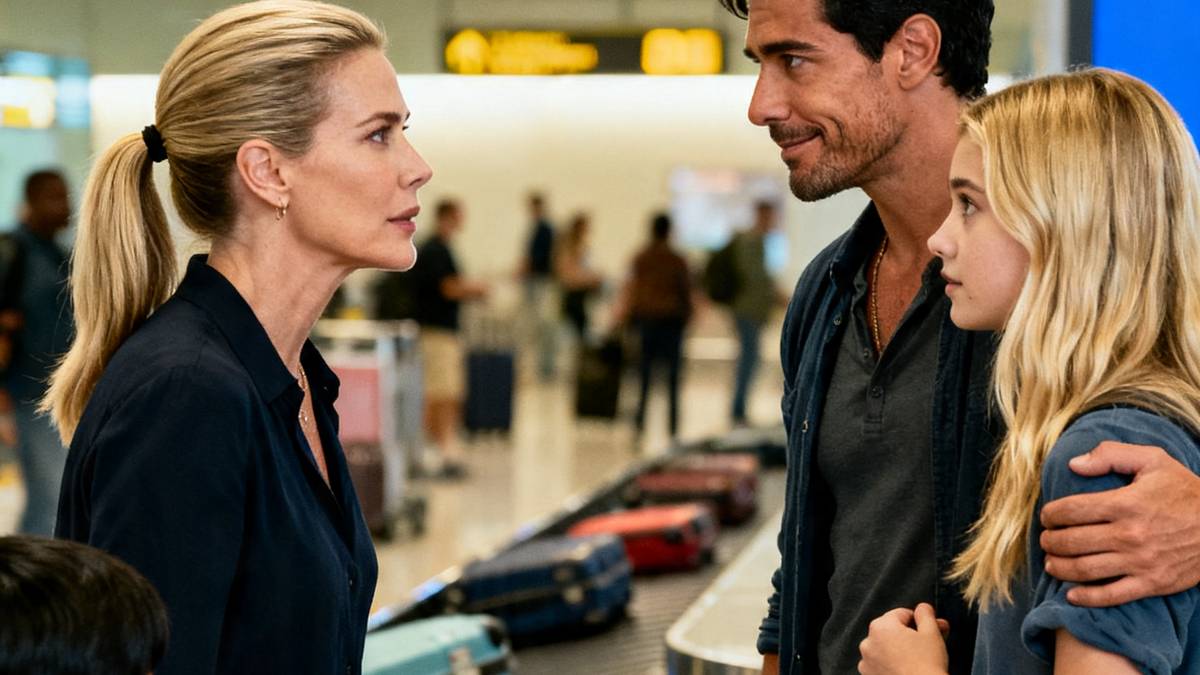
The tour group assembled at the airport in Rome on a cold, bright Sunday afternoon. Twenty-six people total—families, retirees, a smattering of solo travelers. Jessa was scanning the crowd, counting heads to keep Milo and Sophie close, when she saw him.
Marco.
Standing by the baggage carousel with a blonde girl who looked maybe twenty-three. Her hand was tucked into the back pocket of his jeans like she’d been doing it for years. He was laughing at something she’d said, head tilted back, carefree in a way Jessa had never seen him.
He spotted her across the terminal. His eyes went wide for just a second—surprise, something that might have been panic—and then he looked away like she was a stranger. Like they’d never touched. Like his child wasn’t growing inside her at that exact moment.
The blonde said something and he laughed again, pulling her closer.
Jessa felt the world tilt. The noise of the terminal faded to a dull roar. She grabbed Sophie’s hand too tight and the girl said, “Mom, ow,” and Jessa couldn’t find the breath to apologize.
Val appeared beside her with a bottle of water. “You okay? You look pale.”
She stared at him—this man she’d dismissed as boring, as predictable, as not enough—and something cracked open in her chest.
“I’m fine,” she said. “Just jet lag.”
—
They did Rome first. Then a bus through Tuscany, winding roads and cypress trees. Marco and the blonde girl were on the same tour bus, five rows back and across the aisle. Jessa could hear their murmuring, the occasional giggle. Val kept asking if she needed anything—snacks from the rest stop, a sweater when the bus AC got too cold, an extra glass of Chianti at dinner.
He was *there*. Solid. Present. The man she’d married.
On the last night of the tour, a retired schoolteacher from Ohio who was traveling alone stopped by their table at dinner. She looked at Jessa, then at Val, then at Milo and Sophie arguing over a dessert menu.
“You have a beautiful family,” the woman said. “I’ve been watching you this whole trip. The way your husband looks at you—it’s the way I always hoped someone would look at me.”
Jessa’s throat tightened. “Thank you.”
“You’re very lucky.”
Jessa turned to Val. He was trying to settle the dessert debate by suggesting they order all three options and share. The kids were giggling. Sophie had chocolate on her chin.
“I am,” Jessa said. “I really am.”
—
On the flight home she started bleeding. Light at first, then heavier. By the time they landed in Austin and got back to the house, she knew.
She didn’t call an ambulance. Didn’t go to the ER. She just lay down in the bathroom while Val put the kids to bed, and when he found her an hour later, pale and shivering on the tile floor, he called 911 himself.
At the hospital a doctor with kind eyes told her the pregnancy was gone. Probably stress, he said. Probably just one of those things.
“Probably just one of those things,” Jessa repeated.
She signed whatever forms they put in front of her. Val held her hand the whole time.
On the drive home, past midnight, the streets empty and wet from a passing storm, Jessa looked at her husband’s profile against the dashboard lights. He was tired. He’d been tired for weeks and she’d given him nothing but grief.
“Val.”
“Yeah?”
She opened her mouth to tell him everything. The affair, the pregnancy, Marco, all of it. The words were right there, arranged and waiting.
But what came out was: “I love you.”
He glanced at her, surprised. Then he smiled—that small, warm smile she’d first seen at David and Karina’s wedding, the one she’d forgotten how to notice.
“I love you too,” he said.
—
The next morning Jessa sat on the back patio with a cup of coffee, watching the kids chase each other around the yard. The sun was coming up, pink and gold through the live oaks, and the air smelled like wet grass.
All those years she’d thought her gut was infallible. She could read every room, decode every glance, predict every disaster before it unfolded. But when it came to her own life—her own choices—she’d been blind. Not because she couldn’t see the truth, but because looking at it meant admitting she’d been wrong.
Her phone buzzed. Karina.
*You okay?*
Jessa typed back: *Getting there.*
She set the phone down and watched Val come out the back door with a plate of scrambled eggs and a mug for himself. He sat down in the chair beside her. Didn’t say anything. Just sat there, close, the way he always had.
The kids shrieked with laughter. Somewhere down the street a lawnmower started.
Jessa leaned over and kissed her husband on the cheek. He looked at her, puzzled and a little pleased, and opened his mouth to ask a question.
She shook her head. “Just kiss me back.”
He did.


