
The first time Monica hit him, Eddie was scrubbing a lasagna pan in the kitchen sink. The water was hot enough to turn his fingers pink, and he was concentrating hard on a baked-on crust of cheese, so he didn't hear her come up behind him. The blow landed on the back of his head, just above the neck, a flat palm strike that sent his chin jerking forward into the faucet. He bit his tongue. Tasted copper.
"You put my cast-iron skillet in the dishwasher," she said. Her voice was low, almost conversational. "Three years I've had that pan, Eddie. Three years of seasoning it, treating it right, and you run it through the wash cycle like it's a dollar-store cookie sheet."
He opened his mouth to explain, to apologize, to say something, anything, but his tongue was fat and bleeding and the words came out as a kind of wet gargle. Monica shook her head and walked out of the kitchen. She was six feet tall in her bare feet, broad-shouldered from years of competitive swimming, and when she moved through a room, people instinctively flattened themselves against the walls.
Eddie stayed at the sink, letting the water run, watching the last suds spiral down the drain.
He'd been thirty-four when he met her. Thirty-four years old, five-foot-four, 118 pounds soaking wet. He worked the overnight shift stocking shelves at a PriceSmart over in Beaverton, a job he'd taken fifteen years ago because it meant he didn't have to talk to anybody. His world was small: a one-bedroom apartment off Canyon Road, a twice-monthly phone call with his older brother in Tucson, and a standing Friday lunch at a Thai place with his one friend from high school, Danny. That was it. That was the sum total of Eddie Kowalski's life, and he had been absolutely, entirely fine with that.
Monica worked the customer service desk at the same PriceSmart. She was a force of nature, the kind of woman who could make a grown man apologize for standing in the wrong line. She had a laugh you could hear three aisles over, and she wore her auburn hair in a thick braid that swung between her shoulder blades like a metronome. Eddie had been half in love with her for two years before she even learned his name.
The way it happened was stupid. A guy tried to walk out with a DeWalt drill set stuffed under his jacket, and Eddie, for reasons he still couldn't explain, stepped in front of the exit door. Just stood there, all 118 pounds of him, blocking a man who had biceps the size of hams. The guy laughed and shoved him, hard. Eddie went down on the wet floor mat, cracked his elbow, and lay there blinking up at the fluorescent lights while the thief stepped over him.
And then Monica came around the corner, and she didn't step over him. She caught the guy by the collar of his jacket, spun him around, and backed him up against the stacked cases of Gatorade so fast his Nikes squealed on the tile. By the time the security guard jogged over, she had the guy's arm twisted behind his back and was asking him, in a calm, reasonable tone, whether he wanted to try that again.
Afterward, she helped Eddie to his feet. Her hand on his arm was warm and steady. "You're the little guy from dry goods, right? Eddie?"
"Yeah," he managed.
"You okay? That was a hell of a thing you did. Dumb as rocks, but brave."
Nobody had ever called Eddie brave before. The word lodged somewhere behind his sternum and stayed there, glowing faintly, for the rest of his shift.
They started dating six weeks later. Eddie couldn't quite believe it. Monica was funny, she was sharp, she remembered that he liked mint chip ice cream and that he was allergic to walnuts. She told him he was sweet. She called him "my Eddie," and the possessive pronoun made him feel ten feet tall. He proposed on the one-year anniversary of his cracked elbow, down on one knee in the employee break room, holding out his grandmother's ring in a velvet box that had cost him a week's pay. Monica cried. She said yes.
The wedding was small. Danny was the best man. Eddie's brother flew up from Tucson and made a toast about how glad he was that his baby brother had finally found someone who could "reach the top shelf." Everyone laughed. Eddie laughed too.
The cracks started showing about four months in.
Monica had opinions about everything: how the towels should be folded, how the bills should be organized, how Eddie should stand up straighter and speak louder and stop letting people push him around. At first, he found it endearing. She was helping him, shaping him, turning him into a better version of himself. But the suggestions turned into corrections, and the corrections turned into orders, and somewhere along the way, the orders turned into something sharper.
"You forgot to take out the recycling again," she'd say, and then she'd sigh and call him a name. Nothing awful, not at first. "Goofball." "Space cadet." Things that could be passed off as teasing if you squinted. He learned to squint.
Then came the skillet, and the back of the head, and the taste of blood.
He moved out on a Tuesday in March. Danny helped him carry a duffel bag and two cardboard boxes down three flights of stairs to a rented U-Haul van. It was raining, a cold Portland drizzle that worked its way into the collar of his jacket. Eddie didn't cry until they were on the 26 headed west, and then he cried so hard he had to pull over by the zoo exit and wait it out.
That was the winter Eddie decided he was done. Done with people, done with love, done with trying to be something he wasn't. He found a studio apartment above a dry cleaner's on Lombard, bought a single bed, a single chair, a single set of dishes. He worked his shifts and came home and watched cooking shows with the volume low. He was fine.
—
Two months later, he went to Danny's place for a barbecue.
Danny lived out in Gresham in a split-level with a fenced backyard and a grill he'd bought on deep discount after Labor Day. He had a wife, two kids, a minivan, and, as Eddie discovered when he walked through the side gate, a dog that looked like the result of a bar bet.
The dog was long, like a dachshund, but built like a pit bull. It had a deep, barrel chest, short legs that somehow still looked muscular, and a head that was all jaw and mournful eyes. It was lying on the patio in a patch of sun, and when it saw Eddie, it lifted its head, cocked it to one side, and made a sound halfway between a woof and a question.
"That's Ernie," Danny said, flipping a burger. "Don't get too attached. We're trying to rehome him."
"Why? What's wrong with him?"
Danny let out a short laugh. "What's right with him? He dug up the neighbor's rose bushes. He ate a hole through the drywall in the laundry room. He barks at the mailman, the Amazon guy, the meter reader, and, for reasons I cannot begin to fathom, the sound of the microwave." He shook his head. "I feel bad about it, but Trish is at her wit's end. We've got the kids, you know? And Ernie's… a lot."
Eddie crouched down. The dog — Ernie — hauled himself to his feet and waddled over, toenails clicking on the concrete. He was not a graceful animal. He moved like a sofa being pushed across a floor. He reached Eddie's knee and sat down heavily, then rested his massive jaw on Eddie's thigh and exhaled through his nose.
"He's a rescue," Danny said. "Before us, he bounced through three homes in two years. First guy said he was too ugly — his actual words were 'this is not a dog, this is a parts bin.' The second home was an old lady who wanted a lap dog. He pulled her over chasing a squirrel and she broke her wrist. Third was a family with a toddler who kept trying to ride him like a pony." He shrugged. "He's not a bad dog. He's just… nobody ever gave him a real chance. Nobody took the time."
Eddie looked down at Ernie. Ernie looked up at Eddie. The dog's tail gave a single, hopeful thump against the patio.
—
The drive home took forty minutes. Ernie sat in the passenger seat of Eddie's Corolla, drooling on the window, looking for all the world like a creature who had just pulled off an elaborate confidence scheme.
The first week was chaos. Ernie chewed the leg of the coffee table. He barked at the toaster. He had an opinion about the vacuum cleaner, and that opinion was loud and sustained. Eddie, who had never owned a dog in his life, lay awake at three in the morning with a sixty-pound mutant sausage sprawled across his chest, and wondered what exactly he had done.
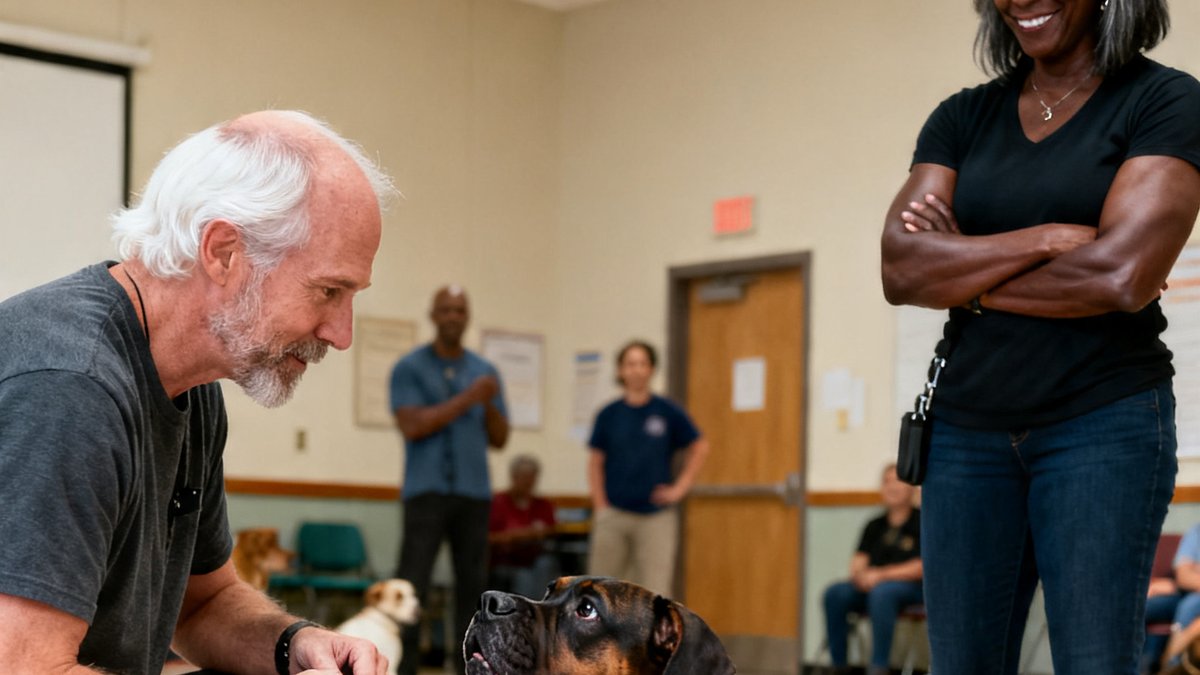
But he kept at it. He read books. He watched YouTube videos by a cheerful woman in Colorado who trained difficult dogs with clickers and hot dog pieces. He signed them up for a basic obedience class at a community center in St. Johns, where Ernie was the only dog who looked like he'd been assembled from spare parts.
The instructor, a patient woman named Carla with grey-streaked hair and forearms roped with muscle, took one look at them and said, "Well, this is going to be a project."
It was. Six weeks of sit, stay, down, heel. Ernie learned "leave it" and "look at me" and, miraculously, "quiet." Eddie learned patience, consistency, and the surprising fact that he was capable of being firm without being cruel. By the end of the class, Ernie could walk on a loose leash, greet another dog without launching himself into orbit, and resist the siren call of the toaster. Mostly.
They started going to the dog park on Sunday mornings. It was a fenced, muddy stretch of grass near the river, always full of the same crowd: a woman with three huskies who never stopped shedding, a retired firefighter whose golden retriever was inexplicably named Steve, and a rotating cast of regulars who knew each other's dogs' names but not each other's.
Eddie became one of them. He learned that the woman with the huskies was named Marta, that she was a pediatric nurse, and that she had a dry, self-deprecating sense of humor that made him laugh in spite of himself. They fell into a routine: Sunday mornings, coffee from the cart by the parking lot, dogs running in circles while they talked about nothing in particular.
One morning in early October, Marta asked him about the thin scar on the inside of his elbow. He told her the truth, about the power drill and the thief and the fall. He told her about Monica, too. Not all of it, just the outline. He'd never told anyone before.
When he finished, Marta didn't say anything for a moment. Then she reached over and squeezed his wrist, once, quick and firm.
"I'm glad you got out," she said.
"Yeah," Eddie said. "Me too."
Ernie was chasing a tennis ball across the wet grass, his weird little legs working furiously, his ears streaming behind him like pennants. He caught the ball, did a victory lap, and then trotted back toward Eddie with his prize held high, the picture of idiot joy.
Eddie bent down and scratched him behind the ear, right where the fur was softest.
The morning sun was pale and thin, the way it always is in Oregon in the fall, but the light caught the river just right, turning the water the color of hammered silver. Marta's huskies were howling about something. Steve the golden retriever was rolling in a puddle. Someone had brought a box of day-old pastries, and the whole park smelled like sugar and wet leaves and dog fur.
Eddie stood there, Ernie leaning warm against his leg, and for the first time in a very long time, he didn't feel small. He felt like exactly the right size.
Marta was saying something about a new coffee place that had opened on Mississippi Avenue, a place that had good pastries and a dog-friendly patio. She was asking if he wanted to check it out sometime. Her voice was casual, but her eyes were not.
Eddie looked down at Ernie. Ernie looked up at Eddie and wagged his tail.
"Yeah," Eddie said. "I think I'd like that."